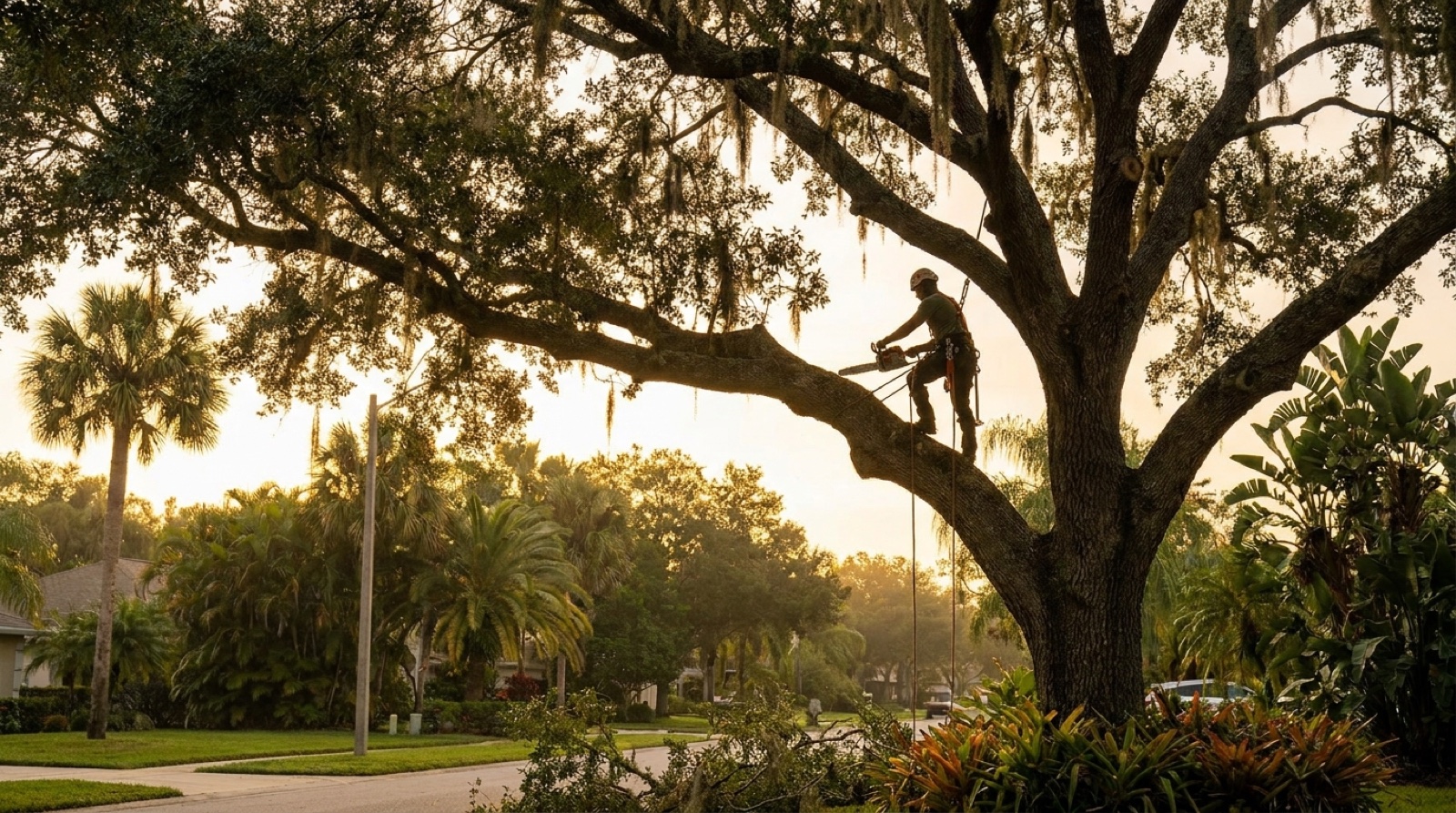
If the trunk and root system are sound, trimming is almost always the answer. If the trunk is hollow, the roots are compromised, or more than half the canopy is dead, removal is the answer.
Everything in between is a judgment call about risk, cost, and how many more years you want out of the tree.
Start With the Trunk and the Roots
Branches are replaceable. A live oak can lose a third of its canopy in a storm and rebuild it over a few seasons.
Trunks and roots are not replaceable. Once structural wood fails, no amount of pruning brings it back.
So the first question is never how bad the canopy looks. It is whether the part holding the tree up is still doing its job.
Signs the structure is still sound
- Bark is intact, with no wide seams, cracks, or open cavities
- No mushrooms or shelf fungus at the base or on exposed roots
- The tree stands straight, or leans the same way it always has
- Soil at the base is flat, with no heaving or lifting on one side
- New growth shows up at the branch tips each spring
Check all five. A tree that passes is a trimming candidate even if it looks rough after a storm.
When Trimming Saves the Tree
Most of the trees homeowners call about in West Palm Beach do not need to come down. They need weight taken off the ends of long limbs and dead wood cleared out of the interior.
Trimming is the right call when any of these apply:
- Limbs are rubbing the roof, the gutters, or the power drop
- The canopy is dense enough to catch wind like a sail
- Dead or broken limbs hang over a driveway, pool cage, or walkway
- The tree has grown lopsided and needs its weight redistributed
- Storm damage is limited to branches rather than the trunk
Regular structural pruning and canopy thinning cuts storm risk more than almost anything else you can do for a mature tree. A thinned canopy lets wind pass through instead of pushing against it.
For a large tree that has outgrown its space, bringing the crown back in often beats removal outright. It lowers the sail area and the leverage on the trunk while keeping the shade.
When Removal Is the Only Honest Answer
Some conditions cannot be pruned away. If any of the following is true, removal is the safe call.
- The trunk is hollow, or a cavity spans more than a third of its diameter
- Fungal conks grow from the trunk or root flare, which signals internal decay
- The tree has developed a new lean, with cracked or lifted soil opposite it
- More than half the canopy is dead and nothing leafed out this season
- Roots were severed during construction, a pool install, or a driveway pour
- The species fails predictably in Florida wind and it sits close to the house
A failing tree does not get safer with time. It gets more brittle, harder to rig, and more expensive to handle as decay spreads through the wood.
That matters across Palm Beach County, where a marginal tree that survives June often does not survive September. At that stage, taking the tree down in controlled sections is a rigging job rather than a chainsaw job.
The Cost Trade-Off
Trimming costs less per visit. Removal is a single larger expense that ends the maintenance line permanently.
| Factor | Trimming | Removal |
|---|---|---|
| Typical frequency | Every 2 to 4 years | Once |
| Cost per event | Lower | Higher |
| Ongoing obligation | Recurring | None after the stump is handled |
| Effect on property | Keeps mature shade | Loses shade and screening |
| Right when | Structure is sound | Structure has failed |
Run the numbers over ten years. Four trimming cycles on a healthy shade tree usually cost less than one removal plus grinding out the stump and replanting.
The most expensive path is paying to trim a failing tree three times before it comes down anyway. If an arborist tells you a tree is structurally gone, further pruning is money spent on delay.
The Gray Zone
Plenty of trees sit between the two answers. The trunk is solid but a major limb has a weak union, or the tree is healthy but planted too close to the foundation.
One option closes that gap more often than people expect. Cables and braces can support a split or co-dominant stem for years when the rest of the tree is stable.
Hardware will not rescue a tree that is already hollow. It works well on a tree that is stressed but structurally intact.
Timing Matters in South Florida
Both jobs get harder and pricier once hurricane season is underway. Crews book out, and emergency work takes priority over planned work.
If you already know a tree is coming down, handling it in winter or early spring costs less and carries less risk than waiting.
The same logic applies to trimming. A canopy thinned in April protects the house in August, while one thinned in September protects nothing that already blew through.
Get a Second Set of Eyes
Anyone can tell you a tree looks bad. The useful question is whether the specific defect is one that pruning addresses or one that only removal resolves.
If you are not sure which side of that line your tree falls on, send us a photo and a few details and we will tell you straight. We would rather trim a tree you get to keep than sell you a removal you did not need.