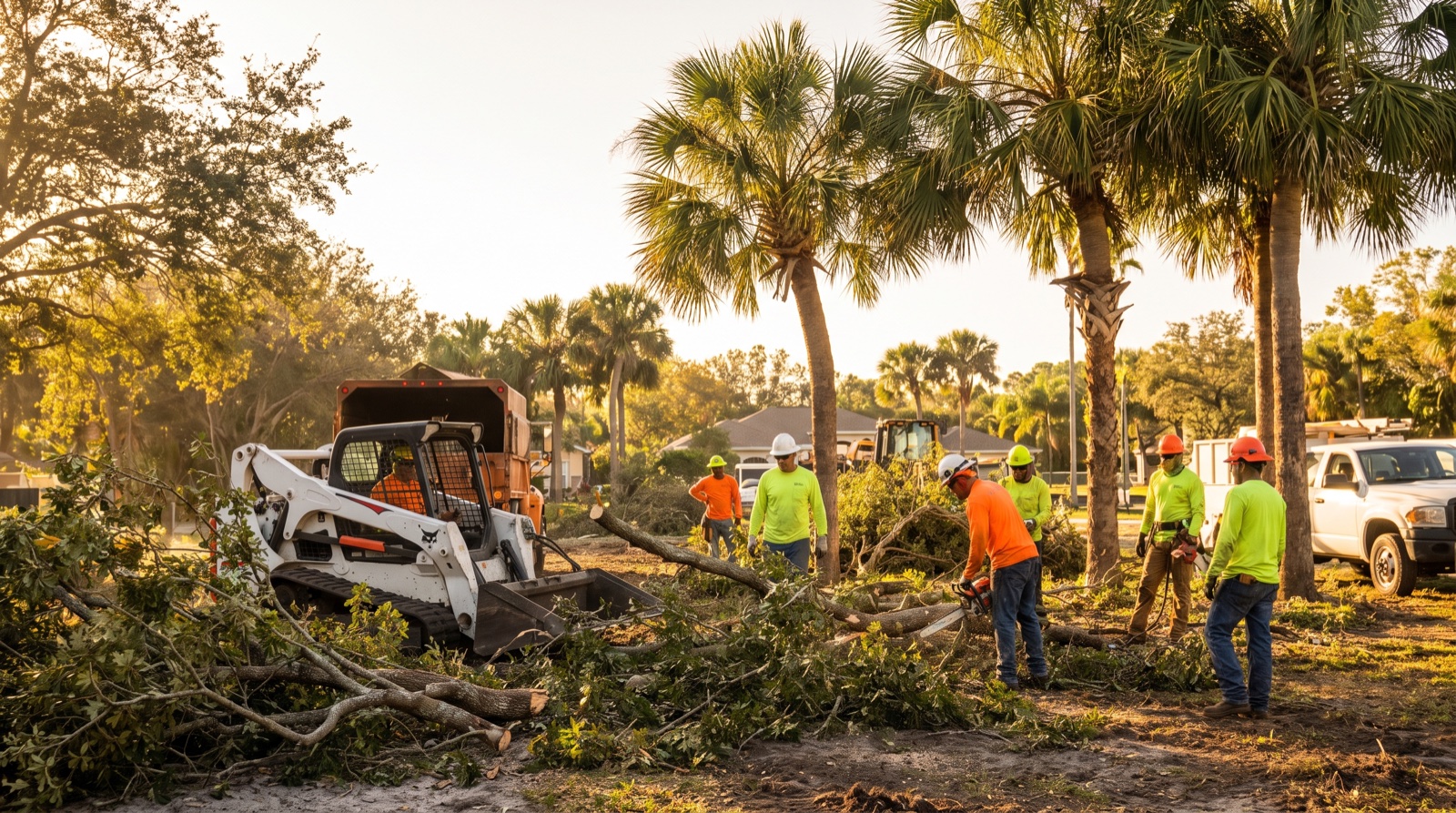
Every redevelopment project in West Palm Beach starts the same way. Somebody has to deal with what is already growing on the lot.
Renderings, permits and foundations all come later. The trees come first.
CoStar reported in late August that a luxury retreat for car collectors is taking shape in West Palm Beach. Newgard Development Group paid roughly $10.5 million for about 2.6 acres and plans 20 privately owned automotive studios with wellness space, padel courts and coworking, with sales expected to open later this year.
That is a normal infill story for this city. A parcel that has been sitting for years becomes a construction site, and the first crew through the gate is a tree crew.
Clearing 2.6 Acres Is Not One Job
Most older parcels in Palm Beach County carry a mix of things: a few decent shade trees, a row of neglected palms, invasive volunteer growth along the fence line and brush nobody has touched in a decade.
Treating all of that the same way is how budgets blow up. The right approach depends on what is actually standing.
| What is on the lot | Usual approach | Why |
|---|---|---|
| A few mature specimen trees worth keeping | Selective removal and pruning around them | Preserves canopy value and usually simplifies the permitting conversation |
| Dense mixed growth across the buildable area | Full lot clearing down to a workable pad | Fastest route to a site the general contractor can actually stage |
| Heavy understory brush over a wide footprint | Forestry mulching | Material stays on site as mulch instead of being hauled to a transfer station |
| Stumps sitting inside the building footprint | Grinding below grade | Stumps interfere with footings, utility runs and compaction testing |
On commercial sites, sequencing matters as much as equipment. Clearing the wrong section first can strand a crane pad or block the only access point.
That is the practical difference between residential work and clearing scheduled around a construction timeline.
The Trees You Keep Are Often the Ones That Die
This is the part that surprises property owners. The removals go fine, and two years later the tree everyone fought to save is thinning out at the top.
Construction kills trees slowly, and almost always through the roots.
Four Things That Do the Damage
- Soil compaction. Excavators and loaded trucks parked over a root zone squeeze the air out of the soil that fine roots depend on.
- Grade changes. Adding a foot of fill over a root plate suffocates it. Cutting a foot away removes it.
- Utility trenching. A single trench for water or electric can sever the structural roots on one whole side of a tree.
- Stored material. Spoil piles, pallets and fuel drums stacked under a canopy for six months do real damage.
Symptoms show up on a delay. Undersized leaves, early drop and dieback in the upper crown often appear two or three seasons after the equipment left.
If a tree on your property has been through nearby construction, a condition assessment and a soil plan are worth more than another round of trimming.
When the Work Is Happening Next Door
Roots do not respect a property line. Neither does a trencher operator working from a plan set that does not show your trees.
Do this before the site work starts, not after.
- Photograph the trees along the shared boundary, dated, from a few angles.
- Note trunk diameter and canopy spread so you have a baseline.
- Talk to the site superintendent early and identify which trees matter to you.
- Ask where utilities and construction access are planned relative to those trees.
A five minute conversation before mobilization is worth far more than a complaint filed after the roots are cut.
September Is the Wrong Month to Have a Wounded Root System
We are in the busiest stretch of the Atlantic hurricane season, and that changes the math on every compromised tree in West Palm Beach, Boynton Beach, Delray Beach and Boca Raton.
A tree that lost part of its root plate to a trench in the spring is not the tree it was. It looks the same standing still and behaves very differently in sustained wind.
If a tree on your lot has been undermined by nearby excavation, the honest options are usually reduction pruning to cut the sail area, support hardware, or removal before the season peaks. Guessing is the expensive choice.
Five Questions to Ask Before a Crew Starts Clearing
- Which trees are staying, and how are they being physically protected during the work?
- Is the quote for selective removal or for clearing the full site?
- Are stumps included, and are they being ground below grade or just cut flush?
- Where is the debris going, and is haul off priced in?
- Is the company licensed and insured for commercial work in Palm Beach County?
Question three catches more people than any of the others. A flush cut looks finished and still leaves a stump that a foundation crew has to deal with, which is why grinding is handled as its own line item.
Whether It Is 2.6 Acres or One Oak
The car collector project will be handled by a general contractor with a full site plan. Most property owners in West Palm Beach are working with less than that.
If you have a lot to clear, a tree that construction has quietly damaged, or a canopy you want assessed before the next storm, get in touch for a walkthrough and a written quote. Call (561) 461-6013 and we will tell you plainly what has to go and what can stay.